
FCL vs LCL: Understanding the Right Shipping Option
Seattle Auto Shipping Editorial Team
March 24, 2026 · 11 min read
Our team of auto transport experts has over 15 years of combined experience in the vehicle shipping industry. We provide accurate, up-to-date information to help you make informed shipping decisions.
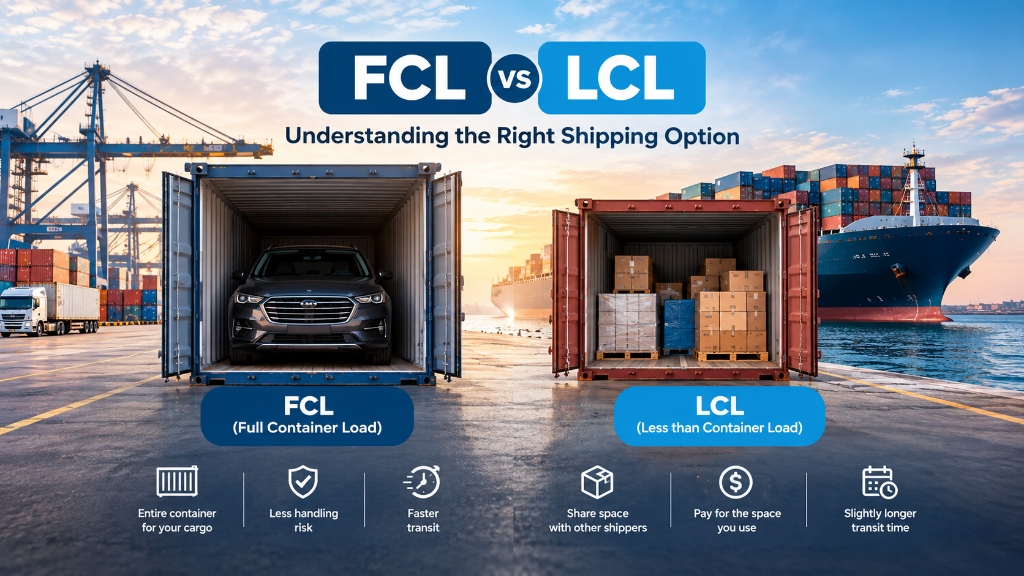
FCL (Full Container Load) means you book an entire shipping container exclusively for your cargo, while LCL (Less than Container Load) means your goods share container space with other shippers. FCL is the better choice when your shipment fills roughly 15 cubic meters or more, because you get lower cost per unit, faster transit, and reduced handling risk. LCL works well for smaller shipments below that threshold, letting you pay only for the space your cargo actually occupies. The right option depends on your shipment volume, budget, delivery timeline, and how sensitive your cargo is to handling at consolidation terminals.
What FCL and LCL Mean in Ocean Freight
Ocean freight is the dominant mode for international cargo movement, and almost all containerized sea freight falls into one of these two categories. Understanding what each term means in practice is the starting point for making the right decision.
FCL: Full Container Load
With FCL, a single shipper books an entire container for their own cargo. The container travels from the origin port to the destination port without being opened, consolidated with other goods, or deconsolidated at an intermediate terminal. The three most commonly used container sizes are the 20-foot (which holds approximately 25 to 28 cubic meters), the 40-foot (approximately 55 to 58 cubic meters), and the 40-foot high cube (approximately 65 to 68 cubic meters).
Importantly, with FCL you pay for the container regardless of whether you fill it completely. If your cargo only takes up 70% of a 40-foot container, you still pay for the full container. This is why FCL becomes genuinely cost-effective only when your shipment volume justifies that fixed cost.
LCL: Less than Container Load
With LCL, a freight forwarder or consolidator groups cargo from multiple different shippers into a single container. Each shipper pays only for the space their goods occupy, typically priced per cubic meter or per tonne (whichever is greater, using a weight-to-volume ratio). The consolidator handles the loading at the origin terminal and a deconsolidation agent separates the cargo at the destination terminal before it is delivered to each individual consignee.
This consolidation process is a core part of what freight forwarders do beyond simply booking carrier space. The freight forwarders vs brokers distinction is that forwarders actively manage cargo consolidation, documentation, and customs filings, while brokers primarily connect shippers to carriers without handling the operational side of the shipment.
Key Differences Between FCL and LCL Shipping
The choice between FCL and LCL affects five core areas of your shipment: cost, transit time, cargo security, documentation, and flexibility. Here is how they compare across each.
| Category | FCL | LCL |
|---|---|---|
| Cost structure | Fixed per container | Variable per CBM or tonne |
| Best volume | Above 15 CBM | Below 15 CBM |
| Transit time | Faster, no consolidation stops | Slower, terminal handling adds time |
| Cargo handling | Minimal, container stays sealed | More touchpoints, higher damage risk |
| Security | High, no shared space | Moderate, shared container |
| Documentation | Master or House B/L | House B/L only |
| Flexibility | Less, container minimums apply | High, ship smaller volumes frequently |
How FCL and LCL Costs Actually Work
Cost is usually the first factor shippers examine, but comparing FCL and LCL pricing requires more than looking at the base freight rate. Both options carry additional charges that affect the final landed cost.
FCL Pricing
FCL freight is quoted per container. You pay one ocean freight rate for the box, regardless of how much cargo is inside. Additional charges typically include the origin handling charge, destination handling charge, documentation fee, and in some cases a fuel surcharge or port congestion surcharge. Because the container is sealed and moves directly, there are no consolidation or deconsolidation fees.
FCL becomes cost-efficient when your cargo fills enough of the container to justify the fixed rate. As a general rule, shippers with cargo volumes above approximately 15 cubic meters will find FCL more economical per cubic meter than LCL on most trade lanes.
LCL Pricing
LCL freight is typically quoted in cost per cubic meter (CBM) or cost per freight ton, whichever produces the higher figure. On top of the base freight rate, LCL shipments carry origin consolidation fees, destination deconsolidation fees, handling charges at the Container Freight Station (CFS), and sometimes minimum charge thresholds even for very small shipments.
These additional handling fees are what make LCL more expensive per unit of space than FCL once shipment volumes exceed a certain threshold. For small, regular shipments where filling an entire container would mean holding inventory until enough product accumulates, LCL is the practical and more cost-effective choice.
Transit Time: Why FCL Is Generally Faster
FCL shipments follow a more direct path. Once loaded at the origin port, the container sails to the destination port and is released to the consignee after customs clearance, with no intermediate stops for cargo handling. This makes transit times predictable and consistent.
LCL shipments require the cargo to be delivered to a Container Freight Station before the sailing date, where it is consolidated with other shipments. At the destination, the container is taken to a deconsolidation facility, unloaded, sorted, and then released or delivered to each individual consignee. These additional steps add anywhere from two to seven days to the overall transit time compared to a comparable FCL route, depending on the trade lane and the efficiency of the CFS operations at each end.
For time-sensitive cargo, this difference matters significantly. When delivery deadlines are firm, FCL removes the uncertainty introduced by consolidation scheduling and CFS processing windows.
Cargo Security and Damage Risk
One of the practical advantages of FCL that shippers sometimes underestimate is cargo security. In an FCL shipment, the container is loaded at the origin, sealed, and opened only at the destination by the consignee or customs. No third party handles the cargo between those two points, which substantially reduces the risk of theft, contamination, or physical damage.
In an LCL shipment, the cargo is handled multiple times. It is loaded at the shipper's facility, transported to the CFS, unloaded, sorted, consolidated into a shared container with other goods, shipped, then deconsolidated at the destination CFS, sorted again, and finally delivered or collected. Each additional handling touchpoint represents an opportunity for damage, particularly for fragile, high-value, or oddly shaped cargo.
For this reason, shippers moving delicate goods, electronics, glassware, or high-value products consistently prefer FCL even when their cargo volume might technically allow LCL, because the lower handling risk outweighs the cost savings of shared container space.
When to Choose FCL and When to Choose LCL
Choose FCL When:
Your cargo volume exceeds 15 cubic meters. You are shipping fragile, high-value, or sensitive goods where minimizing handling is a priority. Your delivery timeline is fixed and you cannot absorb the extra days that LCL terminal processing adds. You need maximum security and control over who accesses the container. You are shipping hazardous materials that require exclusive container use under IMDG regulations.
Choose LCL When:
Your cargo is below 15 cubic meters and you cannot justify the cost of an entire container. You ship smaller volumes on a regular or frequent basis and need flexibility in shipment size. You are testing a new trade lane or supplier relationship and want to keep initial shipping costs low. Delivery timing has some flexibility built in. Your goods are non-fragile and standard in their packaging requirements.
How This Applies to Vehicle and Auto Shipping
For vehicle transport within the United States, the FCL versus LCL distinction does not directly apply since domestic auto shipping uses open or enclosed car carriers rather than ocean containers. However, for importers and exporters moving vehicles internationally, the choice becomes very relevant.
A single vehicle being shipped internationally is almost always handled as an LCL-equivalent, either in a shared container using the Roll-on/Roll-off (RoRo) method or as a single unit in a shared container. Multiple vehicles from the same shipper moving to the same destination are typically more cost-effective in FCL. Working with a strong international freight network that has established carrier relationships across both ocean and road transport modes ensures that the most appropriate and cost-efficient option is used for each specific vehicle shipment.
For domestic car transport, the calculation is different. Carriers operate multi-car trailers, and shippers book by the vehicle rather than by the container. Understanding how carriers price open versus enclosed transport, and what factors affect that quote, is a separate but equally important part of the shipping decision, particularly for specialty or high-value vehicles where enclosed protection is worth the premium cost.
Common Mistakes When Choosing Between FCL and LCL
Choosing FCL for Small Volumes
Booking a full container for a small shipment because it seems simpler or because FCL sounds more secure is a common and expensive mistake. If your cargo is 8 cubic meters, you are paying for the empty space in a 20-foot container. LCL would move the same cargo at a fraction of the cost with a marginally longer transit time.
Ignoring LCL Surcharges
Some shippers compare only the base freight rate when evaluating LCL quotes and are surprised when origin CFS fees, destination handling charges, and minimum charge thresholds inflate the final invoice. Always request a full landed cost breakdown before committing to LCL, and compare it against what FCL would cost at the same volume.
Not Accounting for Cargo Type
Volume and cost are not the only criteria. A shipment of 10 cubic meters of high-value electronics would often be better served by FCL for security reasons, even though LCL would be cheaper based on volume alone. Always weigh cargo sensitivity alongside shipment size when making the decision.
Missing the LCL Cut-off Window
LCL shipments must reach the CFS before a cut-off deadline, typically several days before the vessel sailing date. Missing this window means your cargo rolls to the next available consolidation, adding days or weeks to the total transit time. FCL shipments have more flexible cut-off windows relative to the sailing date.
Conclusion
FCL and LCL are not competing options where one is universally better than the other. They serve different shipment profiles. FCL is the right choice for large volumes, time-sensitive cargo, fragile goods, and situations where security and minimal handling are priorities. LCL is the practical solution for smaller, regular shipments where flexibility and cost efficiency matter more than transit speed or exclusive container use. The 15 cubic meter threshold is a useful starting point, but the final decision should always factor in your cargo type, delivery deadline, budget, and the specific trade lane you are shipping on.
Frequently Asked Questions
What does FCL and LCL mean in shipping?
FCL means one shipper uses an entire container. LCL means cargo from multiple shippers shares one container, with costs based on the space used.
At what volume does FCL become cheaper than LCL?
FCL may become more cost-effective around 15 CBM, but the breakeven point varies by route, container size, rates, and additional charges.
Is LCL slower than FCL shipping?
Yes. LCL usually takes longer because cargo must be consolidated and deconsolidated at freight terminals, adding handling steps to the shipment.
Is FCL safer for cargo than LCL?
FCL generally involves less handling because the container stays sealed from origin to destination, which can reduce damage and loss risks.
Can a single vehicle be shipped in an FCL container internationally?
Yes. A single vehicle can be shipped in an FCL container, offering enclosed protection. It may cost more than other vehicle shipping methods such as RoRo.
Ready to Ship Your Vehicle?
Get a free, no-obligation auto transport quote from trusted carriers today.
Get a Free Quote